
OCT 2
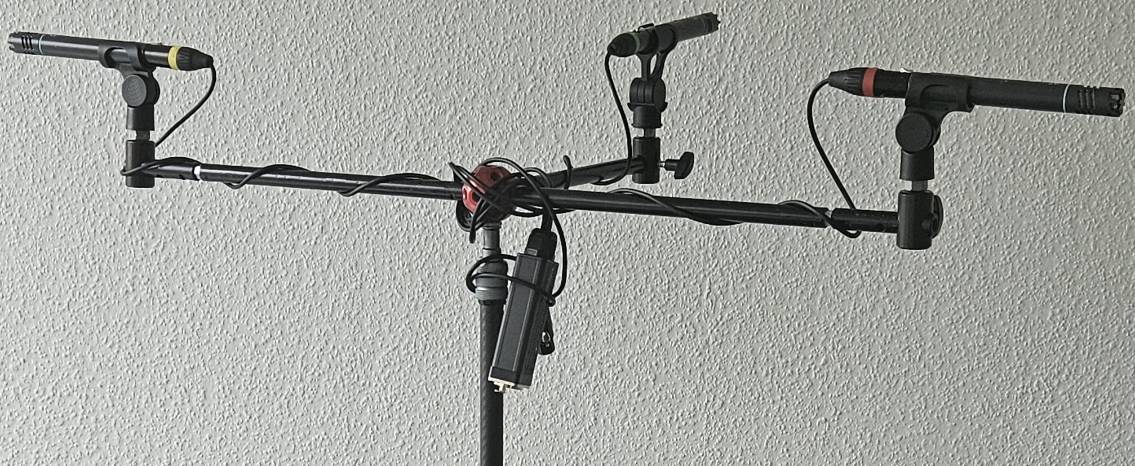
OCT 2 - OCT meets Decca-Tree
You came here because you felt limited by the OCT setup and were looking for a system that combined the advantages of a "Decca Tree" setup with those of the OCT? Then you've come to the right place!
The "Decca Tree" provides extraordinary, immersive reproduction of the recording environment.
OCT is well known for its meticulous and harmonious distribution of auditory elements.
Since both systems are well understood in theory and practice, it's clear why combining them is advantageous.
Upon closer inspection, you will notice that the center cardioid microphone is placed much further forward. In OCT, the cardioid is shifted forward by 8 cm, and in OCT 2, this distance increases to 40 cm. This increases the microphone distances, thus reducing inter-channel correlation. The results in a more spacious ”Decca Tree” type of sound.
All localization capability of the OCT system can be maintained by adding a 1 ms delay in the center channel signal.
When you can use only one system for immersive sounds and 2.0 stereo recording, OCT 2 offers some very special advantages for such demands.
OCT in general has good downmix properties already. Any sound cannot be picked up strongly by all three microphones at the same time at the same level.
Thus level differences, rather than arrival-time differences, provide the primary directional cues, and this minimizes harmful comb filter effects in the direct sound when mixing down to two channels.
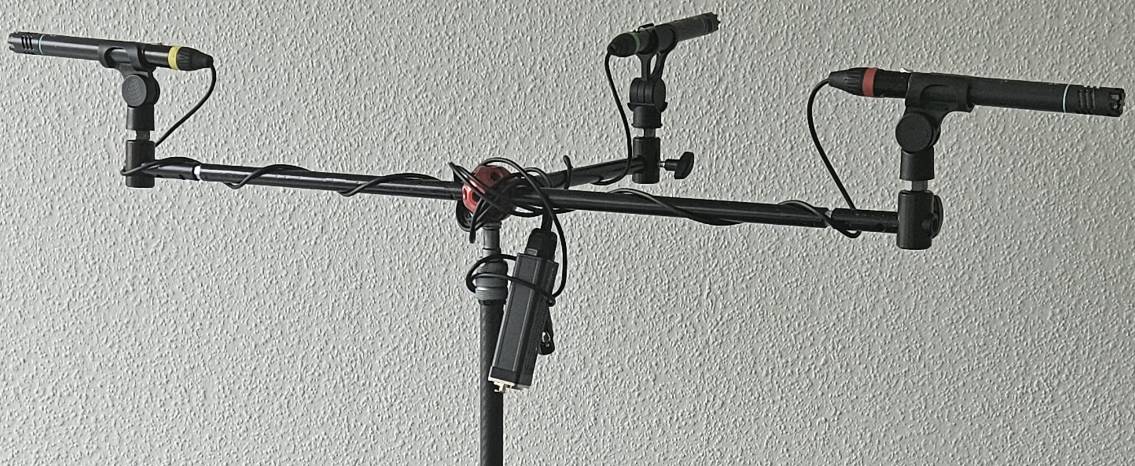
The capsules of the hyper-cardioid microphones are 90 cm away from each other and the capsule of the cardioid is 40 cm further ahead of the virtual line between the both hyper-cardioids. This setup has a SRA of 90°, which is a good choice in many places.
Depending on your demands of the SRA, you can use the same table as with the OCT setup to adjust it to your needs.
Can OCT 2 be extended to an OCT 2-Surround setup?
Of course! - Or, to put it back to you, why not?
It may not be the best solution to all recording situations, but if spatial qualities are key, this should be considered thoroughly.
The change from a "regular" OCT-Surround setup to a "OCT 2-Surround" setup is very easy. The pipe for the front cardioid has to replaced by a pipe, that makes it possible to shift the microphone 40 cm ahead.
Wait a minute! - If you could shift it to either 8 cm or 40 cm, you might shift it to 18 or 24 cm as well!
As shown in the article about the OCT-Surround setup, we now need to add two more cardioid-microphones pointing backwards. They should be placed 40 cm behind the "front bar", and the distance between them should be 20 cm wider than the distance between the hyper-cardioids at the front. The distance between them must not exceed 100 cm!
With this system you are very flexible and don't have to carry too much equipment with you. This is why we like it. You can adjust the spaciousness by shifting the front cardioid back and forth, if you use an adapter that can be shifted easily.
The same applies to the backward pointing microphones.
We didn't measure anything about this, so we could only say what we did above. But we welcome your data and feedback.
You should also read:
Microphone systems (extended)
Microphone systems (extended) Cardioid-based surround array This is an array build of five cardioid microphones with equal distances and angles between them. If you want to know more, please find this article You may know about the IRT cross from our article or from anywhere…
Continue reading...Microphone systems
Microphone systems As there are many different microphone systems one can use in this context, we splitted them into the following categories. Microphone systems (easy) In this category you will find easy to setup and use microphone systems. They are mostly not ambisonic, but of…
Continue reading...
Shopping lists
Shopping lists Here you will find some shopping lists with all the parts you need to setup the described microphone system. PLEASE, PLEASE understand them as what they are intended to be: An example. It may happen, that you have most of the parts in…
Continue reading...Microphone systems (easy)
Microphone systems (easy) In this category we are going to show you how you can setup some microphone systems in an easy way, but you still will get impressive results. But let's start with easy setups first: This is an almost forgotten setup. It consists…
Continue reading...Four SDC-cardioids are very versatile
Four Small-Diaphragm-Condensor microphones with cardioid pattern ... to be precise. Why are we mentioning this here? Because they are extremely versatile and can be used to set up various systems. You can use the four microphones in a cross configuration to make ITU 5.0 surround…
Continue reading...