
OCT - Optmial Cardioid Triangle
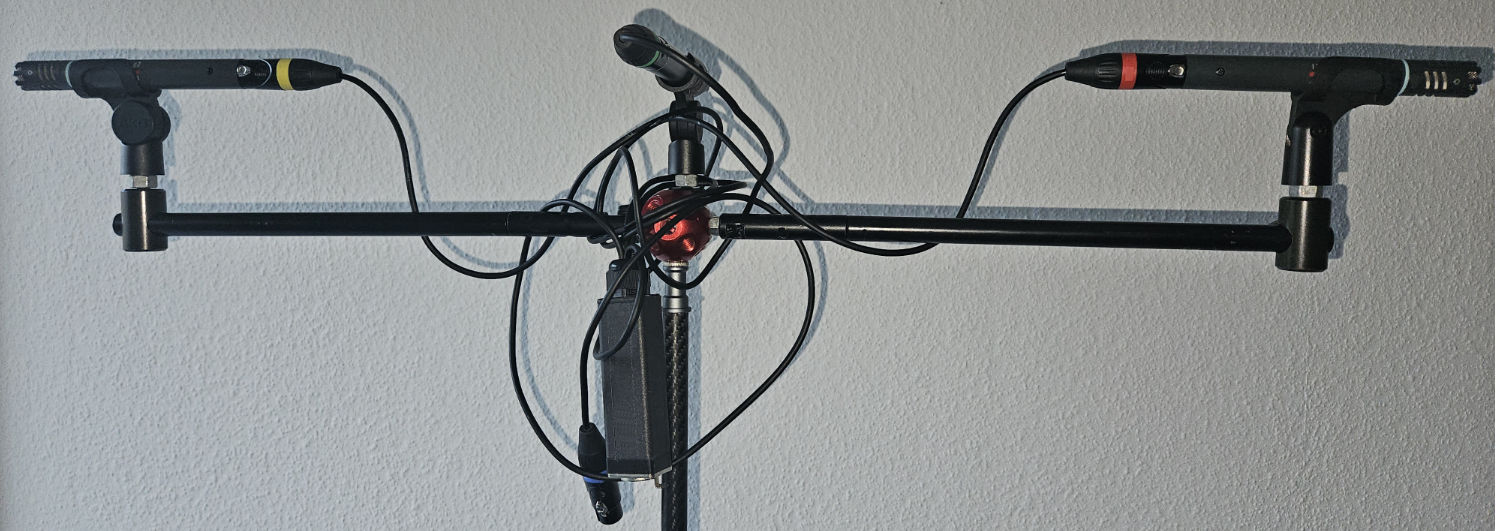
OCT - Optmial Cardioid Triangle
Who could explain it better, than the "inventor" himself: Dr. Gunther Theile.
HERE you'll find a brief description at Schoeps. "[...] OCT is a method for picking up the three front channels of a surround recording. It can be combined with any of several possible methods for obtaining the rear channels [...]"
When the OCT microphone system will be extended with two cardioids pointing to the back, it is called OCT-Surround.
It may also be extended with an IRT cross or a Hamasaki Square. This depends on the current setup, the venue and which microphones are available.
We like the OCT, because it is so easy to setup AND offers the easy adjustment of the recording angle on site.
Super-cardioids aren't necessary for the L/R microphones, bur recommended. Hyper-cardioids or even regular cardioids also work pretty well. However, the distance of the front microphone must be adjusted. Since this depends on the microphone and its pattern, the distance may vary between 7 and 15 cm.
"Let your ears be your judge," and we would like to add, "not your folding ruler."
Please note that the front, or "C," microphone is a standard cardioid. If you use a super- or hypercardioid microphone instead, the sound will jump from the left to the center without a smooth transition.
Additionally, the cardioid suppresses sound coming from the back. This will be a huge advantage when you add additional microphones to make a surround sound system.
The basis is a system of just three microphones:
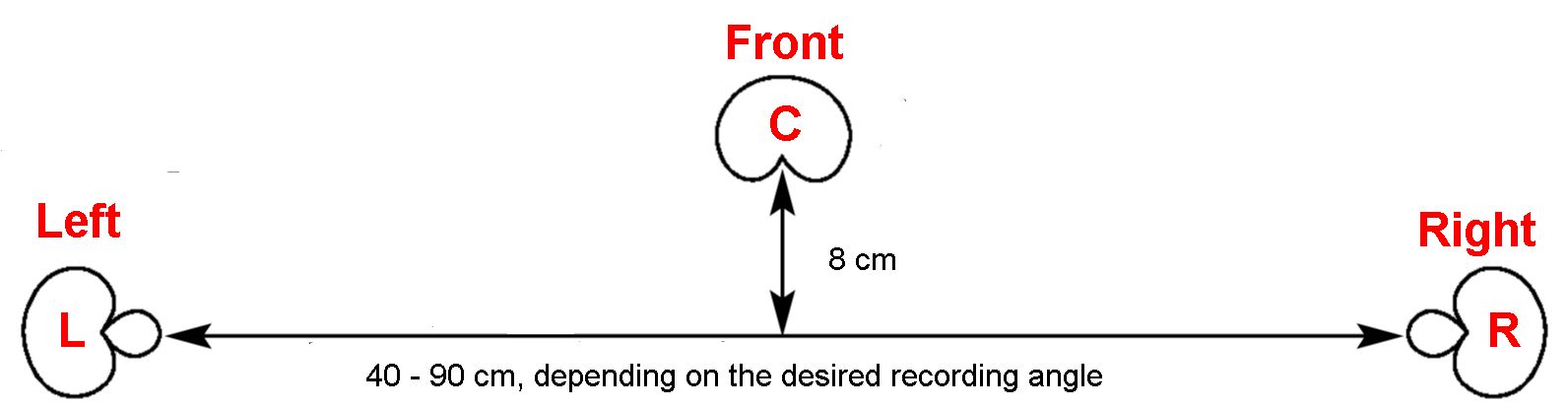
The recording angle depends on the distance between the super-cardioids "L" and "R".
| Distance between mics | recording angle | Distance between mics | recording angle |
| 40 cm | 160° | 80 cm | 100° |
| 50 cm | 140° | 90 cm | 90° |
| 60 cm | 120° | 100 cm | ~80° |
| 70 cm | 110° | >100 cm | may not sound good |
Let your ears be your judge, not your folding ruler. These are just recommendations to help you get started.
A simple rule of thumb is: OCT: Distance between the L/R mic 90 cm = 90° recording angle. As the distance decreases, the recording angle increases and vice versa.
One can do quite nice recordings with this setup. But today it's not so common anymore, as the "pure" system.
Today it serves as basis that will be extended for other purposes and demands.
Such as the "OCT Surround", the "OCT 9" setup, the "OCT 9+" setup and it can be supplemented with other microphone systems to provide a nice soundscape and/or immersive impression.
The OCT microphone system may be combined with an IRT cross or a Hamasaki Square or what ever float your boat.
The tutorial for an OCT setup can be found HERE
If you don't have neither hyper- nor supercardioids ...
You are not lost. You can use regular cardioids instead! - Yes! You got that right!
it works and it works pretty good.
The most significant change you have to make is to put the front mic 12 cm in front instead of 8 cm.
The differences aren't that big in the angles closer to the center, but the further you get from the center, the less good it becomes.
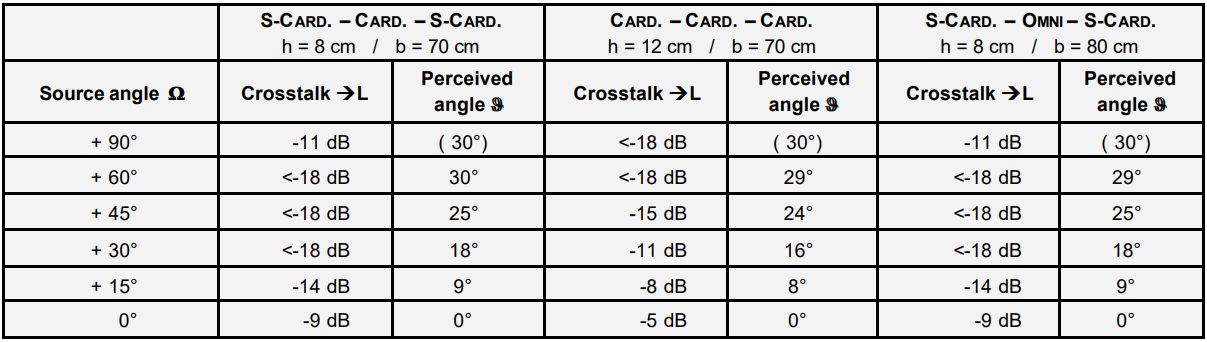
As you can see, the setup with cardioids only, is not too bad. And if you don't have super-cardioids nor hyper-cardioids on hand, the decision is easy, isn't it?
We recommend give it a try and let your ears be your judge. These measurements are here to give you an idea.
This setup works also very well in the OCT-Surround setup
# # # # # # # # # # # # #
You may find the original paper by Dr. Günther Theile helpful if you are interested in more details and background information. Even though the article isn't exactly new, the information it contains is still accurate. However, it does require some technical knowledge of audio equipment to understand it all.