
ECHO project - Penta Sphere
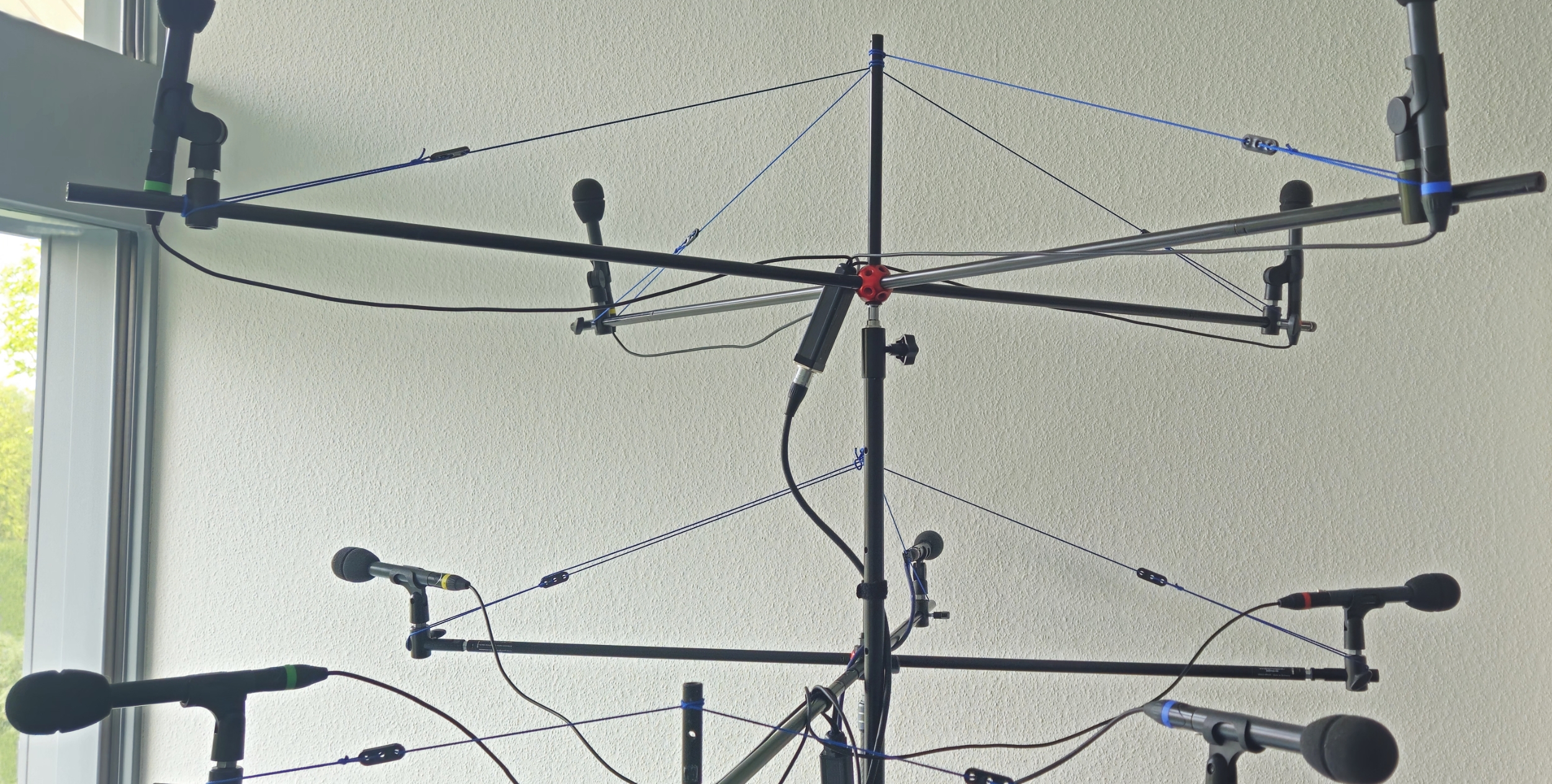
ECHO project - PentaSphere
This is another microphone array of the ECHO project. It has been invented by Anthony Caruso & Kellogg Boynton from the PlayStation Studios.
It can be used as "right in the middle" recording system or "in front of the sound source" as well.
The "Penta Sphere" has a radius around 1.3m. This should provide a great coherence with spherical HRTFs.
When capturing sounds in a circular layout, the focus of the array may be rotated so that any triplet of mics can become LCR for the image, with the option of using opposing top layer mics as a .2 for Atmos mixing.
If your sounds are coming from a certain direction, you may use cardioids as Ls and Rs.

Usually one would use a solid stand and a round plate in the middle with threads at every 72°. Unfortunately, these aren’t available everywhere, but if you know a metal workshop, they shouldn’t be too difficult to make.
We also recommend a 3/8" threaded hole on the top. You can screw a 26 cm long rod, a male/male 3/8" thread adapter and fix the nylon strings onto it as shown in the tutorial.
This allows you to set up strain relief for the microphones using nylon strings—just in case the microphones you’re using are quite heavy.
We always use strain relief to protect our equipment. But opinions on this vary widely.
In the tutorial, we will show you how to set up this interesting microphone array using commonly available equipment. It's not too easy, but it's also not too complicated. As always there is a shopping-list available too.
Our additional thoughts:
We certainly recognize the engineering ingenuity reflected in this design.
But if you look more closely and have some familiarity with the subject, you’ll see that the pentagram represents an arrangement of microphones that strongly resembles a “Williams Star.” or do you know the cardioid-based surround array from DPA?
Sir Mike Williams described a very similar arrangement in the Audio Engineering Society Convention e-Brief Presented at the 131st Convention, October 20–23, 2011, New York, NY, USA, though with cardioid microphones.
That is why the distances in a Williams Star are only about half as large.
The four omnis for the upper plane resemble an IRT cross!
You are right; the distances are much larger than on an IRT cross, but the principle is the same.
The main difference is the low band of frequencies, which omnis pick up much better. So, there is no "better" or "worse"; it's just different.