
Double IRT-cross
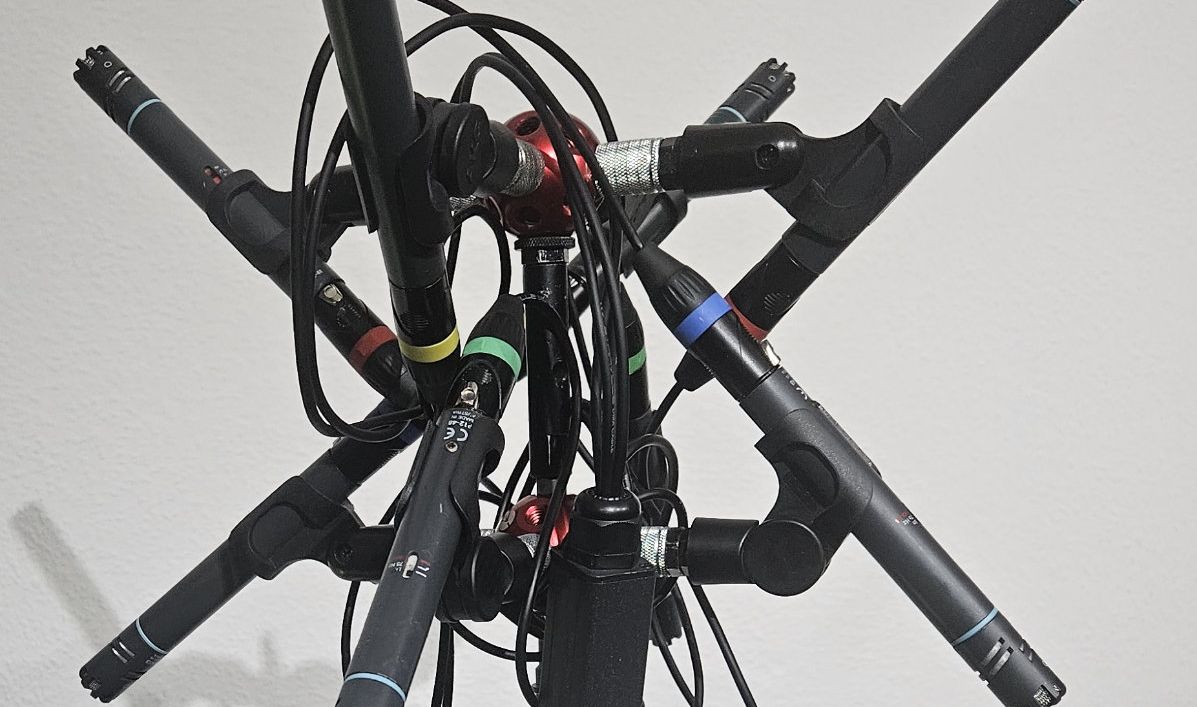
Double IRT-cross
You may be familiar with the IRT cross from reading our article or from other sources. The IRT cross is an excellent option for recording an immersive soundscape, despite being quite old. It has been invented in 2002 by Dr. Guenther Theile.
It has served many sound engineers well, and it still does. But even the best things can be improved upon.
The IRT-cross mainly records sounds in the horizontal plane. It has been designed for this purpose, but it can be extended to a 3D recording system quite easily:
Just add another IRT-cross on top of it.
Then it will look something like this, if you are using SDC microphones like we do.
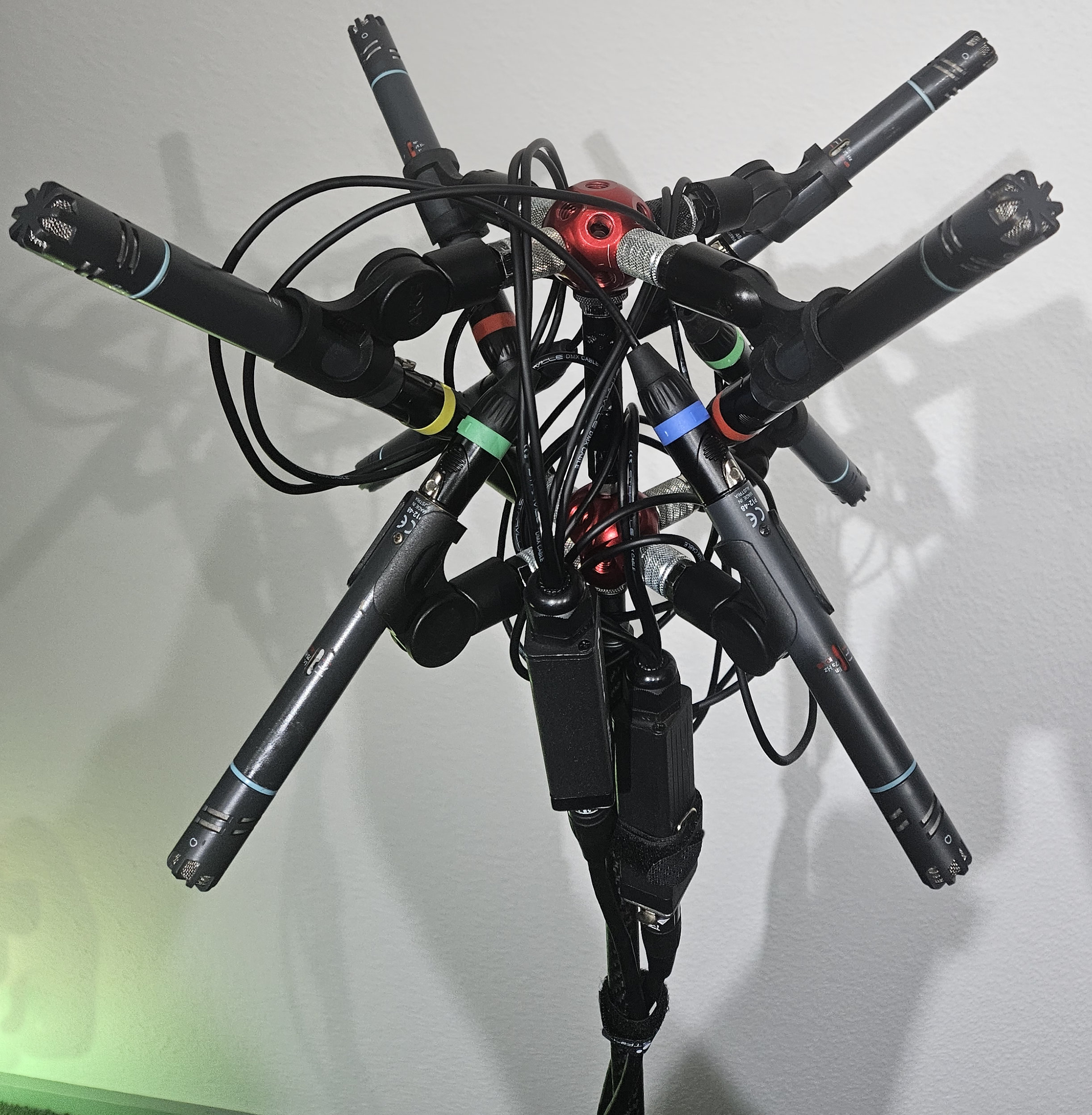
Thomas Rex Beverly is a field recordist and composer who captures sounds that no one has heard before. He recently recorded the sounds of the redwoods in California using a double IRT-cross with LDCs.
If you are interested in learning more about what he did and how he did it, check out his great BLOG . We highly recommend this article. It's well worth your time to read it and listen to the exciting sound examples!!!
Once we have enough LDC microphones, we will try to build a system like Thomas did, ourselves. Until then, we stick to our gear on stock.
The setup of our system was pretty straightforward, once you have all the required small parts on hand.
HERE is the tutorial and the shopping-list.
If you use Reaper, I have a Reaper template and a preset for the IEM encoder for you. With the IEM encoder, you can encode your eight tracks into any ambisonic order (1-7).
The issues we are currently working on are the too long XLR connectors and the wind-shields. The system is already reaching the limits of its stability and with the additional weight of the wind-shields and the load when the wind blows against them is too much for the regular lighting stand we are using.
But a regular camera tripod is too close to the microphones pointing down. We are confident to find a solution for this, but it is not done yet.
Some technical background information
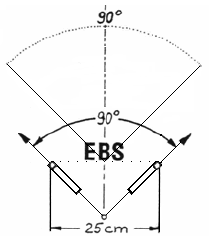
We built a double IRT cross using regular SDC microphones with a cardioid pattern. The distance between each capsule should be 25 cm, and the angle between them should be 90°.
These are the parameters used for an "EBS stereo pair." This is an equivalent stereo microphone system that provides uniformly distributed sounds in the horizontal plane.
That is what we are looking for.
In this setup, the microphones (or their capsules) are all 25 cm apart and have an SRA of 90°. Thus, we have an EBS pair at each edge of the imaginary cube, both horizontally and vertically.
But how can such a recording be reproduced on a multi-channel speaker system? Would it make sense to first create an "intermediate stage in the form of channel assignment according to the AmbiX ambisonic format?
We would appreciate your feedback on this. What has been your experience? What works and what doesn't? If it works, what exactly did you do, and how?
Double IRT cross in Reaper
We'll show you how to do things in Reaper. But this will work in any other DAW as well.
First, we add eight audio tracks and name them so we know which track is which. Then we import the recorded tracks. Next, we add a bus track and route all the tracks to it.
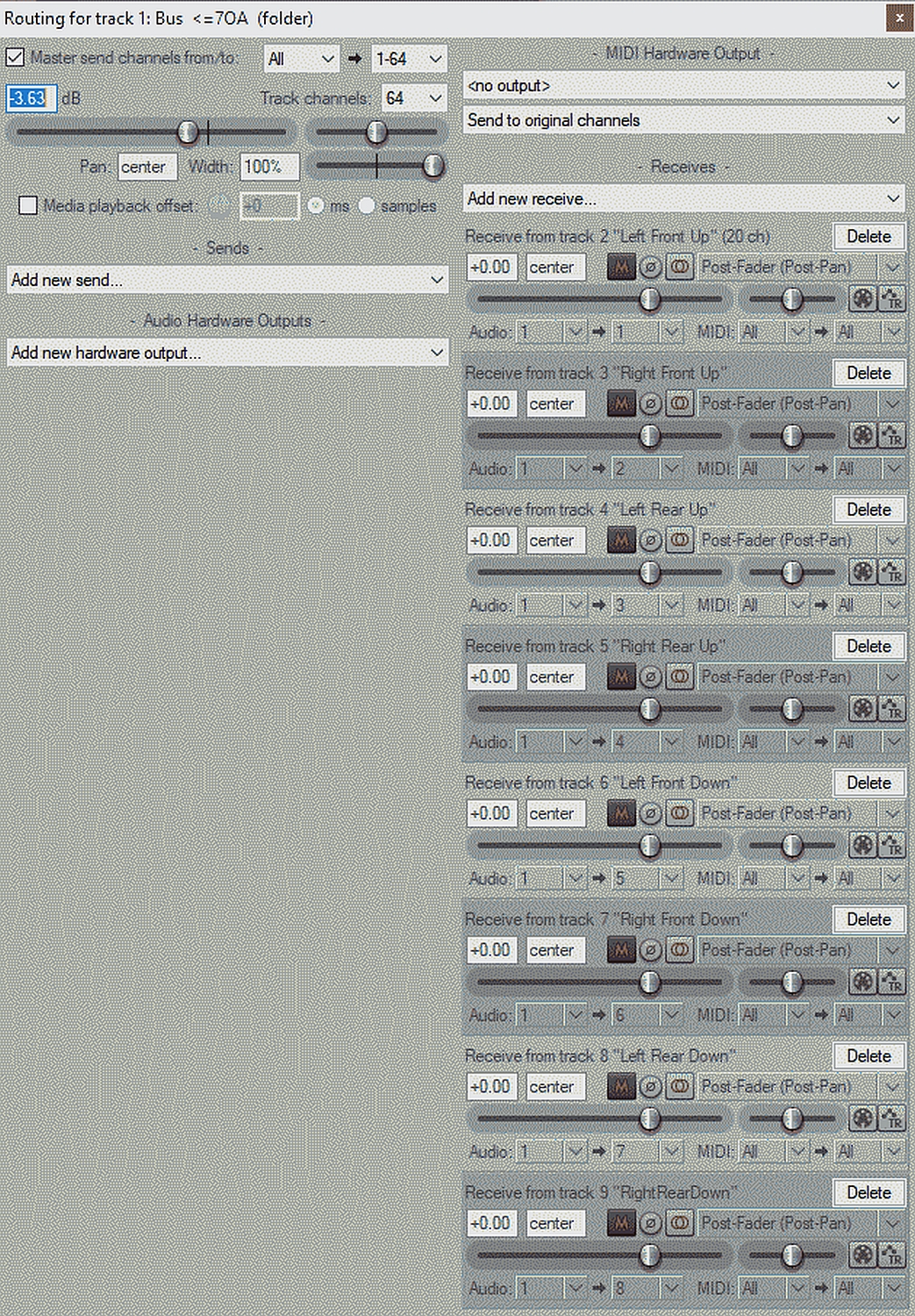
The perspective is in the same direction as the IRT crosses are "looking". But you may change this on your own discretion.
Once we routed all of the eight tracks to the bus, we add the IEM Encoder. You can get it from the IEM website (https://plugings.iem.at).
For your convenience we provide the preset Double_IRT_Cross.RPL which you just import into the IEM Encoder.
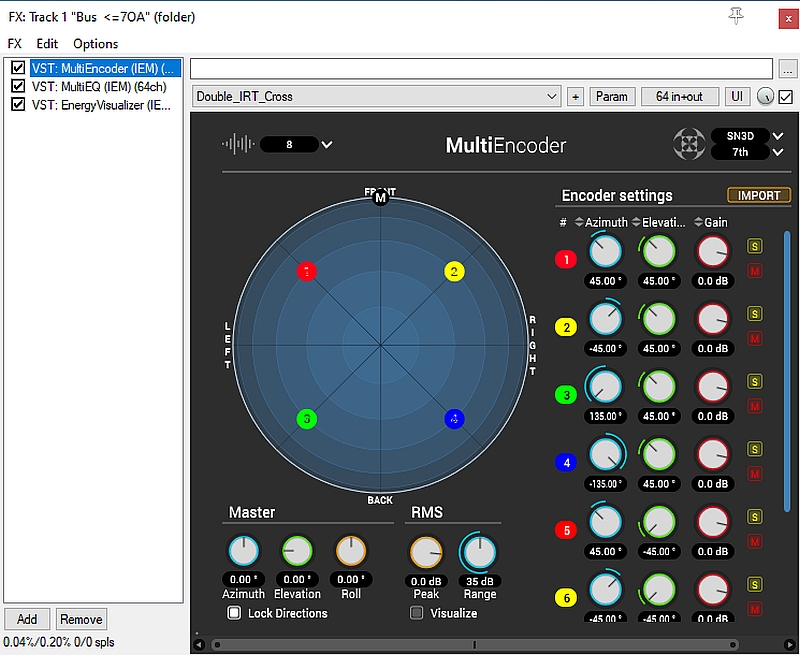
Then your setup will look like this. It comes in handy, when you also add the MultiEQ from IEM as well, or any other EQ, or just none.
The Energy visualizer is very useful, if you are checking the soundscape or just want a nice visualization.
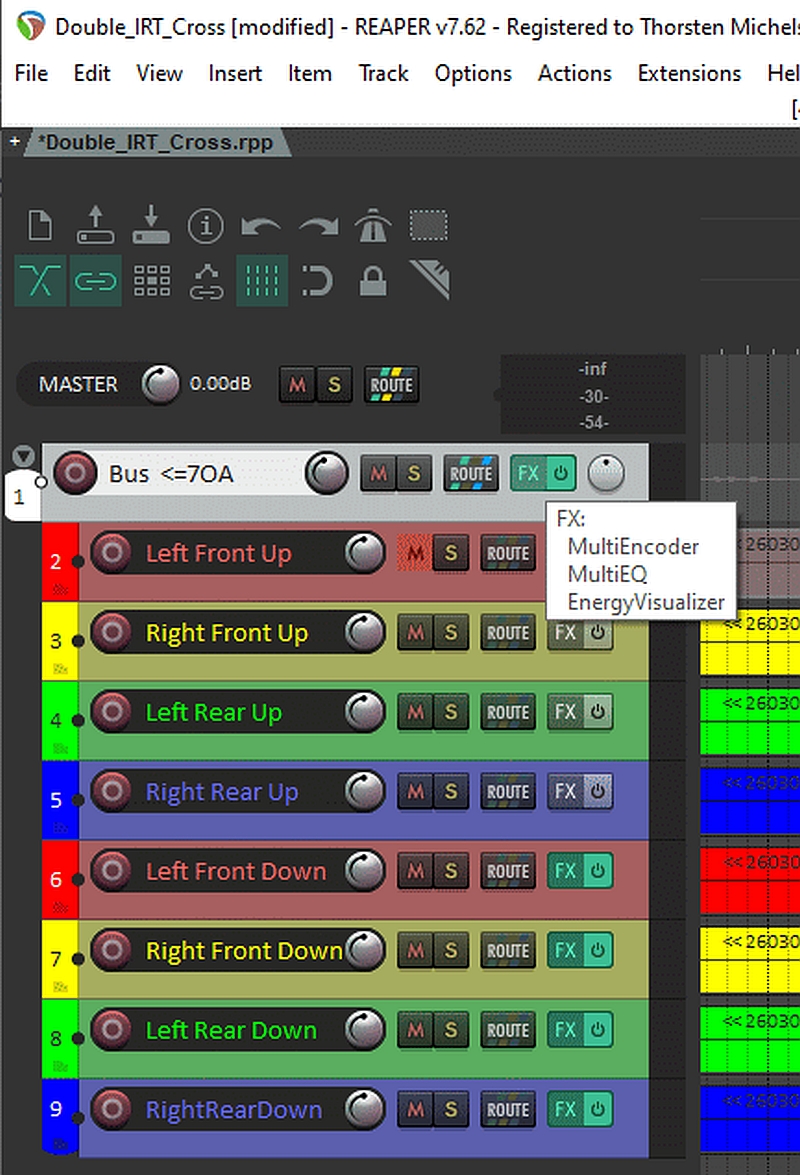
This is how it should look like. You may change the colors. We use the very same ones we use while recording. It's just a question of convenience and personal taste.
Finally you add the IEM Decoder into the master track
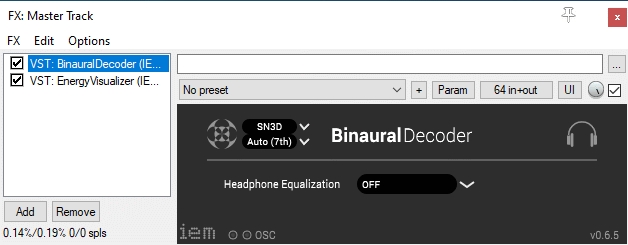
Remember the formula: (Desired order of ambisonic + 1)^2. So for seventh order of ambisonic this will result in (7+1)^2 = 64 tracks.
As there is no penalty for having so much tracks, you should always keep the internal bus that wide.
Now import your recordings, do some tests, put on your headphones and have a great immersive audio experience.
... if you like what you see, please consider a little donation.