
ECHO project - 2L-Prism
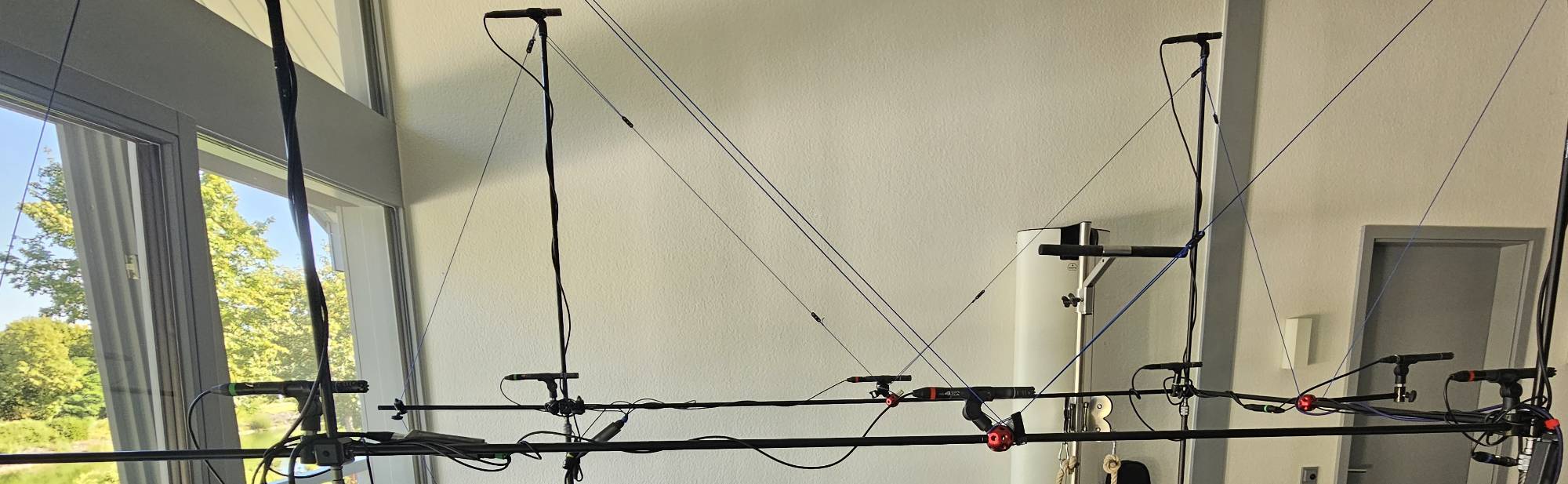
ECHO project - 2L Prism
This is the one of the most fascinating microphone arrays of the ECHO project. It was invented by Morten Lindberg. It is no surprise, then, that it is named the 2L Prism and you can easily tell who his brother is.
It was a long way, and a magic word from a "fairy godmother" was also needed to get it done.
We are now proudly presenting the rebuild of Morten Lindberg's ECHO projects array, the "2L Prism".
Some information upfront - before you start
I had the great honor of speaking with Morten Lindberg himself about the 2L-Prism array.
We collaborated at the worldwide-renowned Galaxy Studios in Belgium to configure a 2L-Prism for a piano recording session.
We changed almost every distance and angle of the standard setup. So the measurements below are more of a recommendation. They aren't set in stone!!!
Here are some general guidelines:
- The larger the recorded sound source, the larger the 2L-Prism should be.
- To find the right spot, walk around the room, make some noise, and find your sweet spot. Place the array there to start.
- Then, make a short recording and listen to it. If you don't have a calibrated speaker array available, start by listening to pairs of microphones in the array. Imagine that they are all stereo pairs. It does require some training, but you will learn quickly.
- Then, you should test what improves the sound and what does not. Since it is a complex system, it is best to change one parameter at a time.
- Everything has an impact on the sound. These include the angle of the microphone, the amount of off- or on-axis, the distance between microphones, and last but not least, the distance between the sound source and the array.
- Setting up this array to capture the room's sound as you experience it may take quite some time. However, it is absolutely necessary and makes the difference between success and failure.
- There is no right or wrong, there is just "does it sounds good?". And you will hear it immediately when you found the right parameters of this array in that room on that time.
Upon closer inspection, you will see that this is an extension of the 2L cube with two additional omnis (Lss and Rss) in the middle.
The challenge lies in the length of the rods and how to maintain stability without significantly increasing the total weight, if you have to extend the size where needed.
We were also forced to increase the number of light stands from three to four. Anything else does not work, or at least, it is not stable, nor sturdy.
The problem here is that it requires eleven (!) omnidirectional microphones whose parameters—such as sensitivity, frequency response, and many others—must be quite similar, or better, as similar as possible. If you don't have such a set, you have to deal with what you got and make the best out of it. This does NOT mean, that it won't sound great. It needs some more adjustments in post.
Since the differences between the recorded signals are determined solely by the time delay (interchannel time difference (ICTD)) , an exact spacing between the microphones is a crucial factor for quality. Exact does not mean you must use your tape measure precisely, it means: Did you already found the best (exact) position for your microphones.
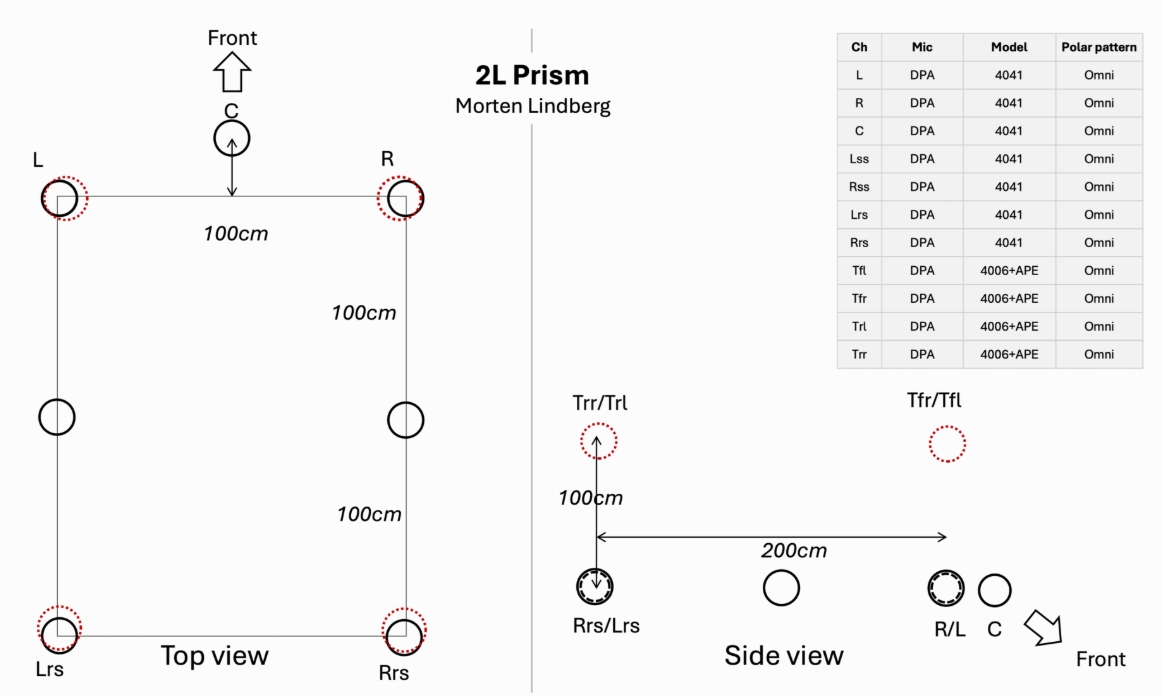
The selection of DPAs 4041 and 4006 demonstrates that this is a highly sensitive system.
Unfortunately, they are no longer available, so you will need to find substitutes. Just make sure you use microphones with the most similar parameters available.
However, the array's exceptional level balance and transparent tonal reproduction, particularly of low frequencies, make it ideal for classical performances, especially in a circular setup. In other words, the array is surrounded by the orchestra. If the sound is not good enough, you should convince the musicians to change their positions in the orchestra. They are usually reluctant, but sometimes it is the only way to make it sound great.
The found "best sweet spot" for the array provides listeners with a unique and fascinating listening experience, many of them never had before.
Typically, the orchestra plays in front of the audience. (More or less.)
With the 2L Prism, however, you put the listener right in the middle of the music.
Give it a try and let us know what your thoughts and feelings are.
A word about assembling this array:
Don’t try to put it together when you’re in a hurry!
It requires a great deal of care and attention to detail. Even though it’s quite sturdy, we’re working very close to the material’s load limits here. So handle with care and caution. Don't be afraid of changing distances, angles and positions. Sometimes your array will look like very modern art, as long as it picks up the sound great - it does NOT matter.
It’s recommended that two people perform the assembly. One person should hold the structure in place while the other continues to assemble or change it.
Good preparation and assembling some "modules" in advance help prevent mistakes that sometimes require unscrewing half the array to correct. Take our word for it.
As with all the arrays we’ve shown, this is our method of assembly—a reproducible approach that yields solid results. But perhaps you have a different—or even better—method. In that case, we’d love to hear your feedback
The tutorial for setting up this array can be found HERE and the shopping list you will find here.
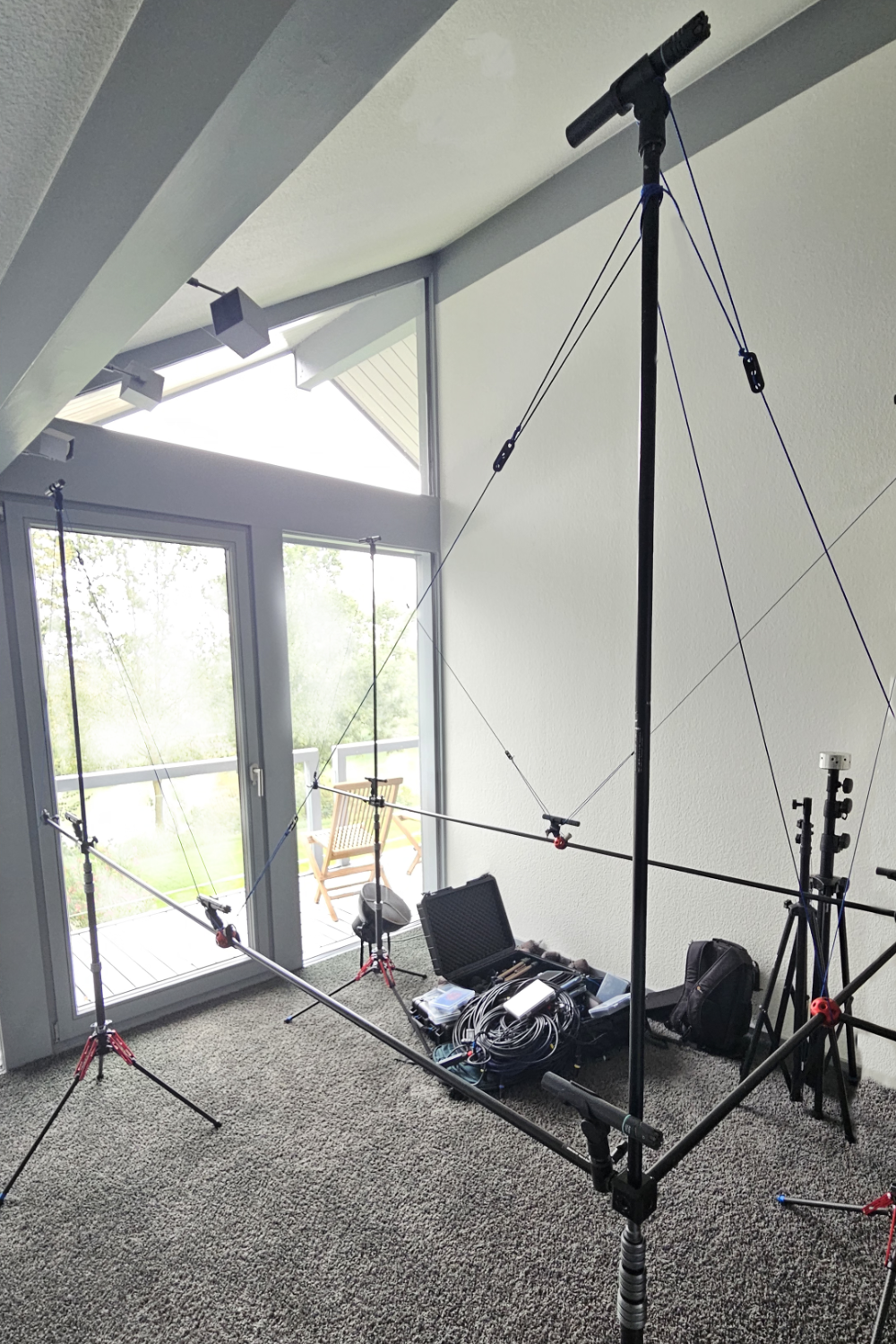
The picture shows an early stage and before you start recording you should bring it up quite a bit. This reduces the reflections from the ground and gives the recording some more "air".
At this height it is much more convenient to set it up.
You should also read:
ECHO project - Practice at home before heading out into the field!
ECHO project - Practice at home before heading out into the field! This advice should apply to almost any setup that you want to take outside. However, it is particularly true for the ECHO project's arrays. These arrays are complex by nature, so if you…
Continue reading...ECHO project microphone arrays - Lessons learned
ECHO project microphone arrays - Lessons learned In this article, we will share links to things we learned while making recordings with the ECHO project's microphone arrays. This is a "living document," meaning it will grow over time. Please check back regularly to see if…
Continue reading...ECHO project - P3H Pyramid
ECHO project - P3H Pyramid This is also a very interesting microphone array of the ECHO project. Unfortunately, we can't replicate this array. We are sorry for saying so, but there is no way to make it happen. While it would be possible from a…
Continue reading...ECHO project - PAMA
ECHO project - PAMA Simon Ratcliffe supposed the PAMA array and it has some very interesting advantages. But let's Simon speak for himself: Objective: Stemming from orchestral film and game music, PAMA (Prototype Atmos Microphone Array) is an in-progress design that aims to extend traditional recording…
Continue reading...
ECHO project - ESMA-3D
ECHO project - ESMA-3D Although Michael Williams published the original concept for the Equal Segment Microphone Array 3D (ESMA-3D) in 1991, Dr. Hyunkook Lee optimized this setup in 2016 using the MARRS ICTD/ICLD-based localization model and augmented it with height channels for 3D recording. But…
Continue reading...