
Basic information about ambisonic
Basic information about ambisonic
This is just a brief overview of Ambisonic, in case you want to refresh your knowledge a little. It is no substitute for an in-depth study of the subject and it never demands it to be.
For a thorough introduction, we recommend THESE books and practise, practise and practise.
Ambisonic A-Format:
This is the individual format a given ambisonic microphone system is picking up sounds. For example. Zoom H3-VR, Octamic, Sennheiser Ambeo, Rode NT-SF1, etc.
Usually the vendor of the system is providing a (software) tool, to convert the signals into the "AmbiX" format, which then can be processed in the common DAWs with additional Plug-Ins.
Ambisonic B-Format:
This is nowadays the most popular and widely used format. Although there are still many recordings available and engineers share their actual recordings in A-Format, for certain reasons.
In this format, the channels are standardized worldwide, making the exchange of recordings quite easy.
The beauty of ambisonics is that you can adjust and customize many things to your liking in the mix and/or post.
Other ambisonics formats
There are some other formats for ambisonic defined: If you want to know the details, THIS link maybe interesting. And, of course the great wikipedia article.
Why ambisonic?
There are no significant advantages to making ambisonic recordings instead of stereo, mono, or multi-track recordings.
The major advantages become apparent when you want to change the position of the "virtual listener."
For example, when this "virtual person" turns their head. In Ambisonics, this is simply a manipulation of a matrix that a computer can perform in fractions of a second.
This makes ambisonic easy to use for atmospherics in video games and radio dramas.
Another major advantage is that you can render almost any other format from an ambisonic recording.
Depending on the "order" of the ambisonic recording, the resulting atmosphere may be more detailed or more immersive.
For example, if you have an FOA ambisonic recording, it's great for setting the scene and atmosphere of a place.
For more detail in the immersive audio sphere, you should have at least a 3OA (third-order ambisonic) recording.
With this, listeners can locate specific sounds more clearly, which may support your story.
There are kits for that. One example is the Zoom H3-VR.
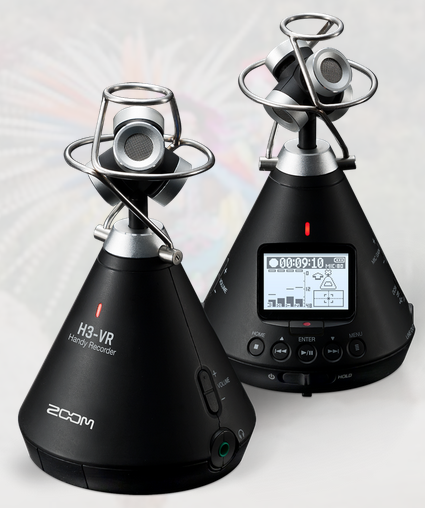
While it's not the best unit money can buy, it may be the one for you if you are looking for a small, handy kit with a real good sound. And the price tag is about USD 250$. Sometimes you can get a deal with a microSD card included.
We like its compact size, long-lasting recordings (up to 4 hours with fresh batteries), and good sound quality.
If you need to have an impression of your recordings in the place where you are recording, binaural monitoring via regular headphones comes in handy.
When traveling, you can mount this recorder on a small camera tripod, take care of some wind protection and ... hit the record button.
But if you already have a handheld recorder and at least three SDC microphones with a "cardioid" pattern and some additional hardware than you should check out our articles in the Microphone systems (easy) section. There you will find some information about how to build your own First Order Ambisonic (FOA) microphone systems and start recording.
There are plug-ins to render a FOA recording into a higher order ambisonic scene. Don't expect miracles and unicorns, but for some purposes, converting a FOA recording this way is a serious alternative, but it has its limitations.
Converting from higher order to FOA is also possible, but you may need other plug-ins. It depends on the vendor.
You should also read:
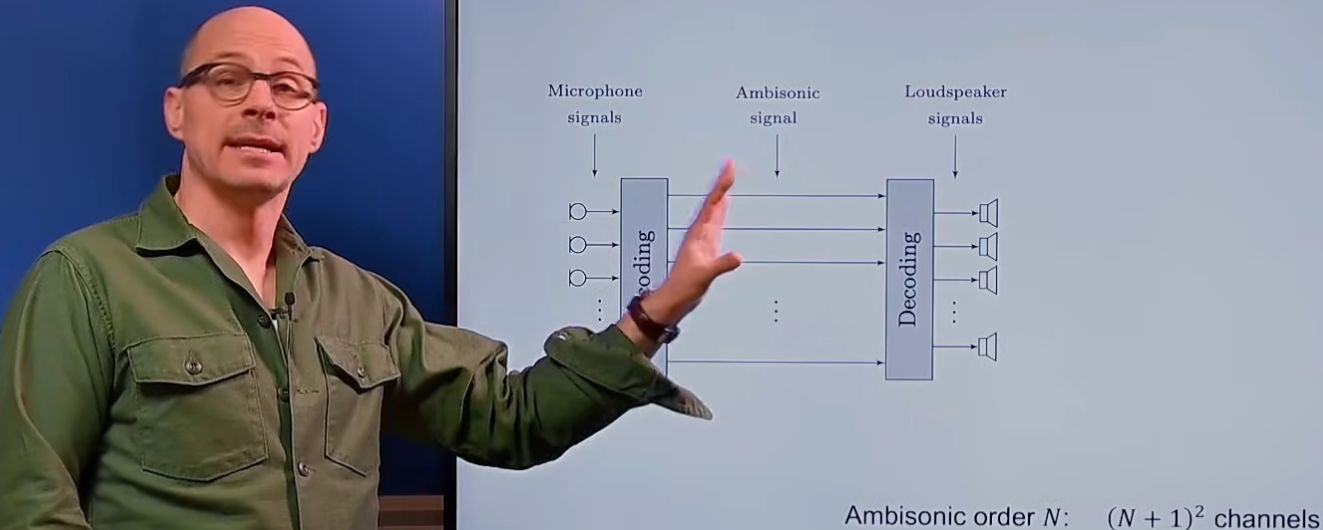
Tutorials - Ambisonic
Tutorials - Ambisonic Due to some demand, we are providing links to tutorials about Ambisonics. These are NOT our own. Please note that these links are provided for your convenience only, and we are not responsible for their availability or content. When we checked these…
Continue reading...Ambisonics - Tutorial
Ambisonics - Tutorial Sometimes you get known to a person and get new information. We have decided not to create another introduction or tutorial on ambisonics. There are already so many of them, some of which are quite good, so there is no need for…
Continue reading...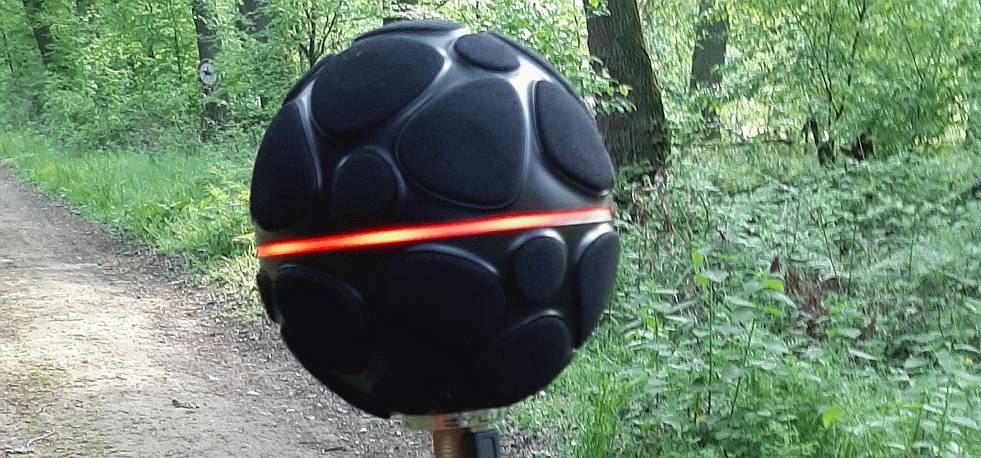
Ambisonic microphone systems you can buy
Ambisonic microphone systems you can buy Zylia ZM-1 If you have some money saved up and are looking for an extraordinary high-order ambisonic microphone system, you may want to try this: People sometimes sell the Zylia ZM-1 on eBay for an attractive price because they…
Continue reading...General information
General information Here you will find several articles and other information to guide you on your way to ambisonic. Let's start with the DOs and DONTs. This article does not demand to be complete, but being a kind of a living document. Details will be…
Continue reading...Books about ambisonic
Books about ambisonic When it comes to books about ambisonic, every list starts with this great book: When we started with ambisonic, this was THE source of knowledge and it still is. If, like us, you have forgotten more about matrices than you ever learned,…
Continue reading...