
Art and Science of Immersive Recording
A Meeting of Art and Science
When Hyunkook Lee and Grammy Award-winning mixer/producer Andrew Scheps first connected at the AES International Conference on Spatial and Immersive Audio, it was the beginning of a fruitful collaboration. Andrew, impressed by Hyunkook's organ recital recording, described the experience: "When we listened back to the exact same recording, just mapped channel to speaker, no processing whatsoever... it was breathtaking. The low end was just absolutely amazing."
What captivated Andrew was how the recording didn't just recreate but enhance the live experience. "I'm watching the feet hit the pedals, and it was like, 'oh, there's something low.' But in the recording, the power and emotional response to the pedals on a church organ was there in a way that it wasn't in the room."
The Fundamentals of Immersive Recording
At the heart of this conversation is the approach to capturing natural soundscapes in three dimensions. Developed after years of research at the University of Huddersfield's Applied Psychoacoustics Lab, Hyunkook's techniques address a fundamental question: How should microphones be arranged for height channels in immersive audio?
"The traditional approach is having spacing between all microphones," Hyunkook explains. "But I came up with this idea: our ears are horizontally spaced, but everything from above is picked up at one point. So do we actually need spacing?"
Three Main Approaches to Immersive Arrays
According to Hyunkook, there are three main approaches to immersive microphone arrays:
- Horizontally spaced, vertically spaced - Arrays with spacing between all microphones
- Horizontally spaced, vertically coincident - maintains horizontal spacing but has coincident vertical placement
- Horizontally coincident, vertically coincident - Fully coincident approaches like Ambisonics, which have some advantages but require sitting in a precise sweet spot
The key concept in Hyunkook's preferred technique is a horizontally spaced, vertically coincident array. This approach allows for natural spatial reproduction while maintaining excellent downward compatibility to formats like 5.1 and stereo.
The Science Behind the Technique
Hyunkook's journey with his recommended microphone array technique "PCMA-3D" began in 2013 with a series of experiments on the effect of microphone spacing on spatial impression. "We found that none of [vertical] spacings made any difference. 0, 0.5 meter, 1 meter, 1.5 meter didn't make any difference," Hyunkook explains. This revelation became the foundation for his array design.
The technique was originally developed as a 5.1 array with "one microphone [sub-array] pointing forward and the other microphones pointing backwards," allowing engineers to mix these signals to create "virtual zoom-in and zoom-out effects" with more ambience when steered toward the back or more direct sound when pointed forward. (A similar technique is the “OCT-3D" technique developed by Theile and Wittek)
After his 2013 experiments, Hyunkook realized he could "angle it more upwards so you can actually pick up the main sound and the height at one point, just like our ears capture the sound."
PCMA-3D Versions and Configuration
The PCMA-3D is a flexible technique with the key concept being a horizontally spaced, vertically coincident array (The ORTF-3D technique shares the same principle).
Hyunkook explains that the standard configuration includes:
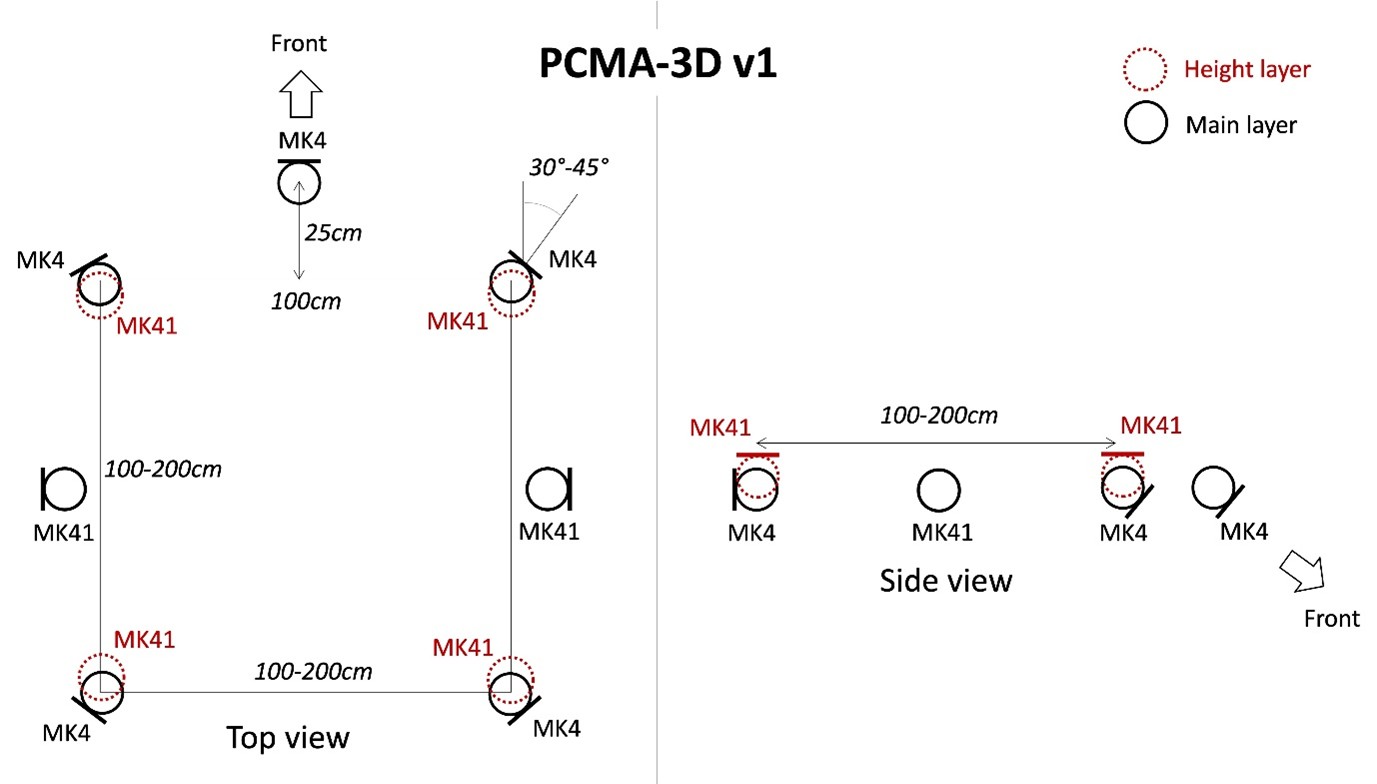
- LCR (Left-Center-Right) microphones typically spaced one meter apart
- Front microphones arranged with approximately 45 degrees subtended angle from center
- Center microphone placed about 25 cm from the base point
- Rear microphones positioned about one meter from the base point
- Side channels for 7.1.4 using side-facing supercardioids
For the PCMA-3D Version 1, the height channels use a coincident technique with supercardioid microphones (typically Schoeps CCM 41 or MK 41) pointing directly at the ceiling, arranged coincidentally with the main microphones. "The advantage of this is it's super easy to fold it down to 5.1 or stereo. You don't actually add any tonal coloration other than the reverb just added to the signals," says Hyunkook.
For the PCMA-3D Version 2, which Hyunkook used for organ recordings, he introduces some spacing between the main layer and the height layer. "When I did the organ recording, I added a little bit of spacing because it's all about harmonic reconstruction, because the organ is such a large instrument," Hyunkook explains. This spacing creates a different tonality because with such a large instrument, "it's not about ambience anymore because you capture direct sound from the organ."
This variation employs wide cardioid capsules (e.g. Schoeps MK 21) or diffuse field equalized omnis (e.g. Schoeps MK 2H) for LCR.
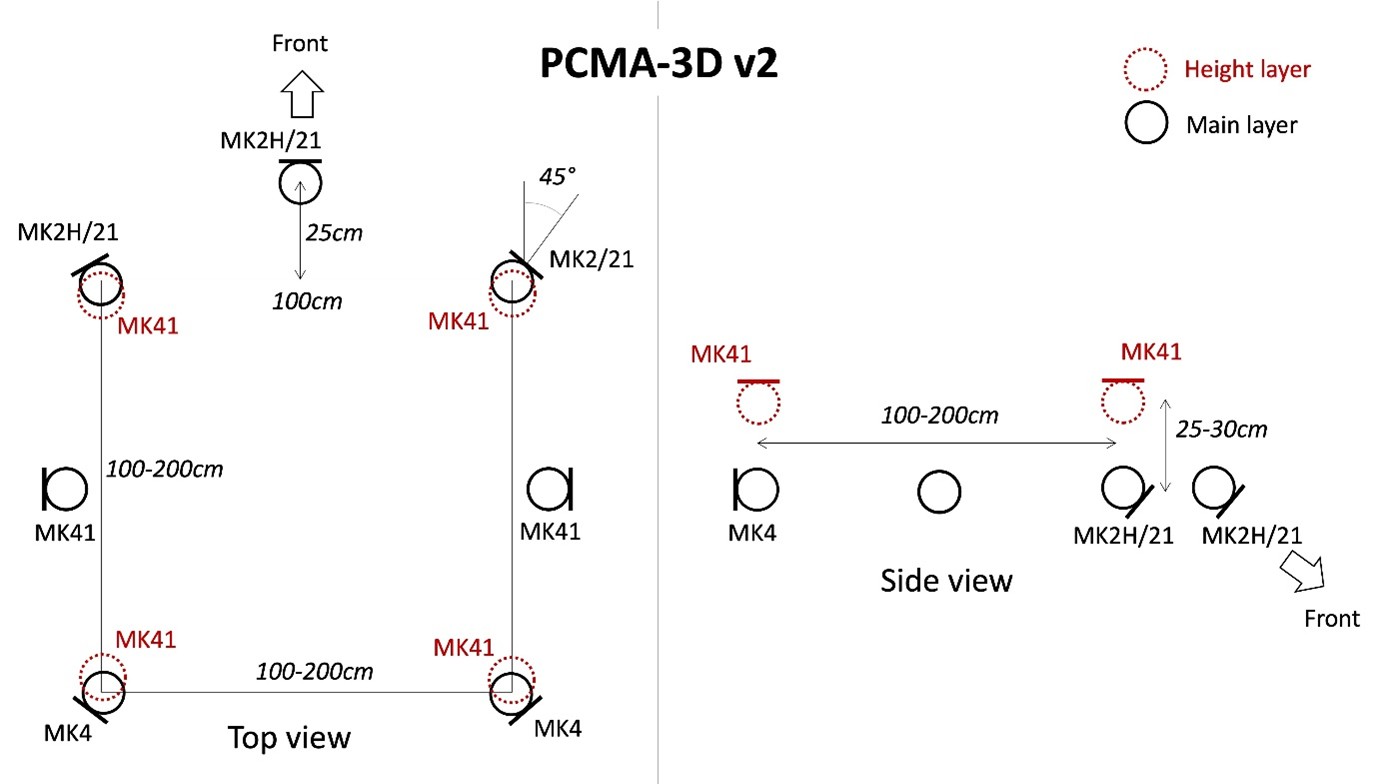
The choice of microphone capsules also varies depending on the source material. For orchestral recordings, Hyunkook recommends omni capsules like the Schoeps MK 2H diffuse field equalized omni capsule to capture more low-end. However, even with omni main microphones, he emphasizes that "for the height layer, supercardioid works just perfectly."
[Take from the website: https://schoeps.de/en/knowledge/user-reports/art-science-of-immersive-recording.html]