
ECHO project - PAMA
ECHO project - PAMA
Simon Ratcliffe supposed the PAMA array and it has some very interesting advantages.
But let's Simon speak for himself:
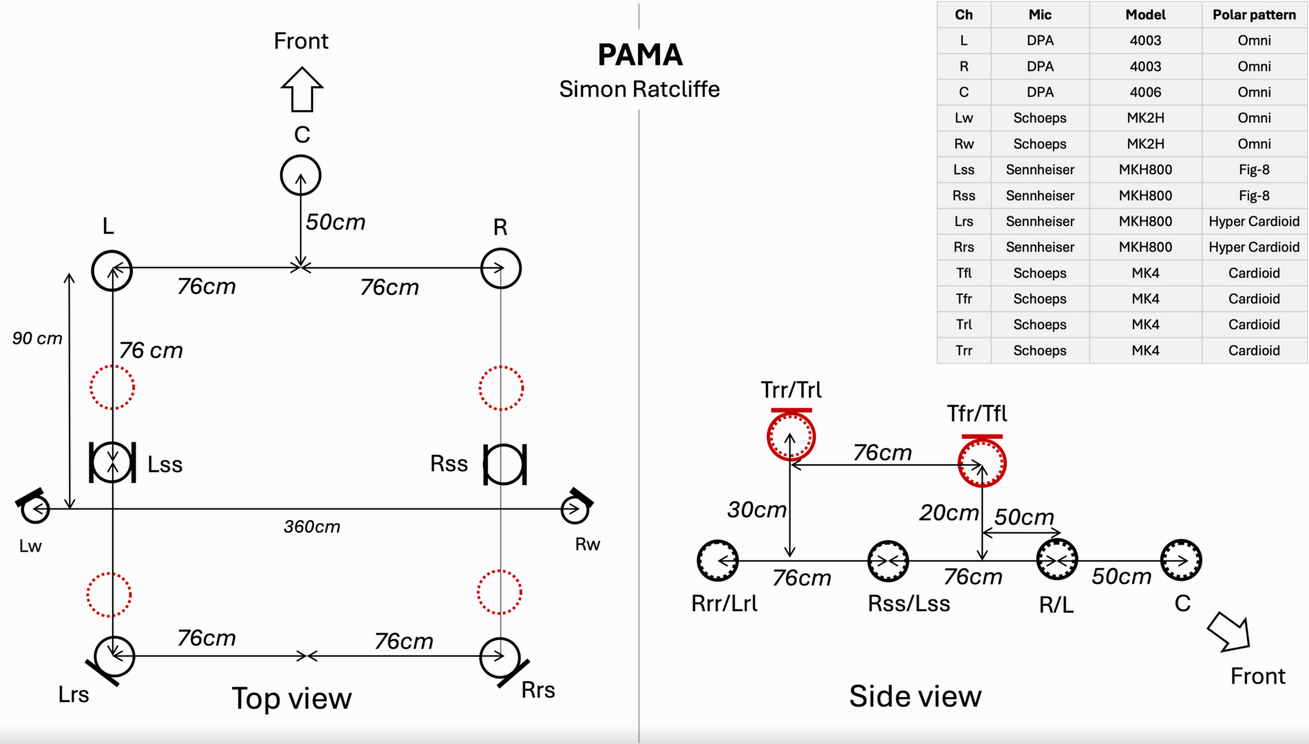
Objective: Stemming from orchestral film and game music, PAMA (Prototype Atmos Microphone Array) is an in-progress design that aims to extend traditional recording configurations into the immersive space, while ensuring Dolby Atmos compatibility across theatrical and home entertainment platforms, and consecutive fold-downs and workflows typical of media score delivery.
Configuration: Anchored on a modified Decca Tree + wide pair, and extended by sides, rears and height microphones, reflecting 7-0-4/9-0-4 speaker configurations. By addressing the beds, but preserving the heights as a quad-width object, a combination of speaker arrays and front-to-back height can be addressed to extend the soundstage.
The array seeks to self-correct observed issues for theatrical and HE playback by a combination of polar patterns. 1) The use of bidirectional microphones help with the observed side-surround/surround array high load of information (especially in the lower mids) characteristic of omnidirectional microphones, we well as extending the natural ambience of the recordings through their non-directionality, and in combination with the rear super-cardioid microphones and wide channels, work well in decorrelation and provide good fold-down characteristics when delivering stereo or 5.1, as well as binaural Atmos. The height channels assigned as overhead objects, when panned 75% in from from and rear cardinal points, suitably address theatical arrays and HE systems in facilitating overhead L/R and F/R, further addressed by the rear Height mics being 10cm higher than the fronts." [source]
As always, we are trying to strip down the weight and use as few gear as possible.
But this array is a real challenge.
We know that the availability of SDC figure-of-eight microphones is very limited. This is especially true if you are on a budget. Great options include the Sennheiser MKH800 (used in the original setup), Schoeps, and other Sennheisers. After that, the choices become very limited.
Also, keep in mind that the microphones have different sensitivities. This may make it difficult to set your gains.
It's a pity that AKG has decided to sunset their "blue line." However, if you act quickly, you might find your microphones on "well-known online vintage gear selling platforms".
The tutorial and shopping list are available and ready for your testing.
It should be noted that this system reaches the limits of the type of array setup we use.
It cannot be extended very high. The limit is reached at about 1.5 meters above the ground.
If you want to go higher, you need more stable tripods. These are heavier, more expensive, or both.
The outrigger microphones also stand on tripods that, while very light and compact, aren’t particularly stable. Here, too, different tripods are needed if you want to go higher.
The total weight of the array is about 23.3 kg, or roughly 51 pounds. It’s heavy, and to prevent damage to the backpack, we prefer to carry the three multicore cables by hand.
This reduces the weight of the backpack to about 18.5 kg. That’s heavy enough.
But, anyway! Have fun and make some awesome recordings.
You should also read:
ECHO project - Connecting Microphones to Recorders
ECHO Project - Connecting Microphones to Recorders When you come here from the former article, "ECHO project - Practice at home before heading out into the field!", you've come to the right place or the next step, just as you like. We use four-channel multicores…
Continue reading...ECHO project - Practice at home before heading out into the field!
ECHO project - Practice at home before heading out into the field! This advice should apply to almost any setup that you want to take outside. However, it is particularly true for the ECHO project's arrays. These arrays are complex by nature, so if you…
Continue reading...ECHO project microphone arrays - Lessons learned
ECHO project microphone arrays - Lessons learned In this article, we will share links to things we learned while making recordings with the ECHO project's microphone arrays. This is a "living document," meaning it will grow over time. Please check back regularly to see if…
Continue reading...ECHO project - P3H Pyramid
ECHO project - P3H Pyramid This is also a very interesting microphone array of the ECHO project. Unfortunately, we can't replicate this array. We are sorry for saying so, but there is no way to make it happen. While it would be possible from a…
Continue reading...
ECHO project - ESMA-3D
ECHO project - ESMA-3D Although Michael Williams published the original concept for the Equal Segment Microphone Array 3D (ESMA-3D) in 1991, Dr. Hyunkook Lee optimized this setup in 2016 using the MARRS ICTD/ICLD-based localization model and augmented it with height channels for 3D recording. But…
Continue reading...