
Artificial head
Artificial head
Several models were available in the 1970s. The vendors were the "usual suspects": Neumann, Sennheiser, and AKG.
Their different approaches resulted in units that sounded unique. The Neumann KU 80, the Sennheiser MKE 2002, and the AKG D99c "Harry."
All of these models are well known, and you can find pictures of them online. Some units are still available, and people are rebuilding the "Harry" in particular.
This is quite doable but results in a rather heavy artificial head.
Several models were available in the 1970s. The suppliers were the “usual suspects”: Neumann, Sennheiser, and AKG.
Their different approaches resulted in devices with unique sound. The Neumann KU 80, the Sennheiser MKE 2002, and the AKG D99c “Harry.”
All of these models are well known, and you can find pictures of them online. Some devices are still available, especially the “Harry” model, which is currently being reissued.
This is entirely feasible, but it results in a rather heavy artificial head.
However, as promised, we strive for solutions that are both effective and affordable. Therefore, we opted for an acrylic sphere with a diameter of 17 cm, some insulation wool from a no longer used hi-fi speaker, two silicone ears, and two small microphones with omni characteristics.
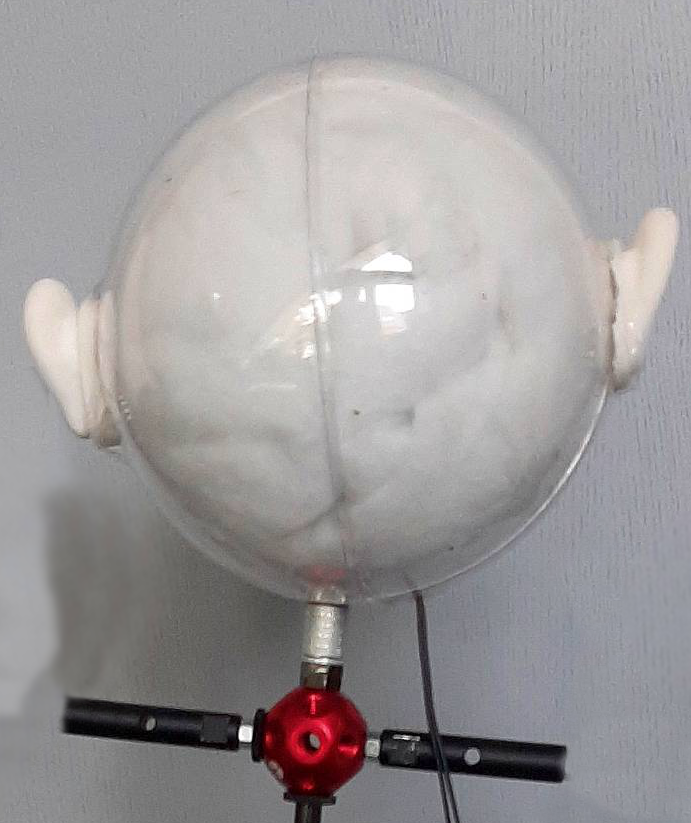
The acrylic sphere can be purchased online or in craft stores for very little money.
We still had the insulation wool from the speaker in stock, but you can use any fabric that is as fluffy as possible. This absorbs resonances and reflections inside the sphere.
Then cut or drill holes into the silicone ears. The diameter should be slightly smaller than that of the microphone capsules. This will hold them in place easily and you can change the microphones later if you like.
The silicone ears are now glued to the outside of the ball. Either with normal household glue or some silicone. Let the glue dry completely before you continue.
Insert the microphones into the ears from the inside of the sphere, then feed the cables out of the ball. You may need to drill an additional hole.
In order to screw the sphere onto a microphone stand, you will need to drill another hole in the bottom of the sphere. Make sure it is centered. Ours was "almost" centered.
We used clear adhesive tape, the kind you find in offices, to stick the two halves together. This allows us to easily open the sphere again for maintenance.
It's time for your first recordings! Connect the microphones to your handheld recorder and check if phantom power is needed. Then, press the "Record" button and start recording.
You'll be amazed by the results, proving that you don't need to spend a fortune to make binaural recordings with an artificial head.
Did we mention, that the Neumann KU 100 costs about 8,800 USD? (https://www.thomannmusic.com/neumann_ku100.htm).
There's no doubt that the results will be much better with less self-noise from the microphones.
Save your money, and once you have enough, purchase a KU 100.
In the meantime, your artificial head will serve you well, and you can achieve decent results with denoising techniques. But that is a topic for another article.